SCI editor Doug Gerlach explains why high-quality micro-caps may offer some of today's most compelling opportunities.

A hallmark of a maturing bull market is the gradual evaporation of low-hanging fruit. As capitalization-weighted indices climb and valuations among larger-cap equities stretch toward historical extremes, the task of uncovering true mispricings requires investors to look beyond familiar horizons.
Since the start of 2026, a healthy rotation has begun to breathe life into the small-cap segment, prompting many of our favorite names to experience significant price appreciation and multiple expansion. Yet, as the broader small-cap universe climbs, the most compelling opportunities have quietly floated to the top of our watchlists in an often-overlooked corner of the market: the micro-company space.
In the SmallCap Informer, we define this sandbox as public companies generating under $100 million in annual revenues. Because these businesses are virtually invisible to Wall Street analysts and institutional funds—which are restricted by liquidity constraints—they trade in highly inefficient environments. When a micro-cap experiences a fundamental turnaround or taps into a massive secular tailwind, its share price does not adjust gradually; it moves violently as the market belatedly wakes up to its true earnings power.
Our approach to these diminutive enterprises is grounded strictly in our Quality-GARP (Quality and Growth At a Reasonable Price) methodology. We do not participate in speculative, debt-laden "pre-revenue" biotechnology plays or unproven start-ups. Instead, we hunt for highly profitable, self-funding micro-caps that dominate specialized niches, boast clean balance sheets, and possess high insider ownership.
Recent developments among several of our active coverage picks—including M-tron Industries (MPTI), Pro-Dex (PDEX), Taylor Devices (TAYD), and Alpine Income Property Trust (PINE)—illustrate how executing this playbook can shield a portfolio from macro volatility while unlocking substantial capital appreciation.
When seeking quality-first micro-caps, we prioritize businesses whose products are absolutely mission-critical, creating a wide technological moat and immense pricing power. Taylor Devices is a good example. With a long legacy of innovation sparked by its founder’s liquid spring patents, Taylor Devices designs and manufactures highly engineered motion control and energy dissipation solutions. Their dampers and custom isolators protect critical civil infrastructure, like bridges and skyscrapers, from seismic winds, and shield sensitive defense systems worldwide. Because these tools are a matter of physical safety and operational survival, customers prioritize reliability and engineering depth over finding the cheapest supplier.
Operating in a similarly insulated defense niche is M-tron Industries, which has been an outstanding performer since we initiated coverage in September 2024. Spun off from The LGL Group in 2022, M-tron is highly specialized, generating $44.7 million in trailing twelve-month revenues as of mid-2024. While its small size introduces additional short-term volatility, the company occupies an incredibly high-value niche: designing highly engineered radio frequency (RF) filters, oscillators, and integrated microwave assemblies for commercial aerospace, electronic warfare, and space markets.
In the medical instruments arena, Pro-Dex (PDEX) represents another growth micro-cap that has successfully transformed its legacy contract manufacturing model. Headquartered in Irvine, Cal., Pro-Dex designs, develops, and manufactures autoclavable, battery-powered and electric multi-function surgical drivers and shavers used primarily by surgeons in the orthopedic, thoracic, and craniomaxillofacial (CMF) markets.
By acting as a leading OEM supplier of orthopedic robotic end effectors—which serve as the critical physical interface between robotic surgical arms and the patient—Pro-Dex has deeply embedded itself into the supply chains of major medical device giants like Medtronic and Johnson & Johnson. Its proprietary intellectual property, which includes patented adaptive torque-limiting software to prevent screw stripping and optimize hardware seating, commands premium pricing and high margins.
While these three companies represent our high-octane growth engines, a balanced small-cap portfolio also requires a reliable anchor of defensive, compounding income. Alpine Income Property Trust serves this role well. Alpine is a small, externally managed triple-net lease (NNN) REIT. In an NNN structure, the tenant is contractually obligated to pay all property-level operating expenses—including real estate taxes, insurance, and maintenance—freeing Alpine from overhead and property management costs.
Alpine's portfolio of 128 single-tenant retail properties across 34 states is leased to an impressive list of national, defensive retailers. Its ten largest tenants by annualized base rent include giants like Lowe’s, Dick’s Sporting Goods, Walgreens, Best Buy, and Walmart. Critically, 51% of Alpine's rent is derived from investment-grade rated tenants, providing an incredibly stable cash flow base.
How to Address Micro-Cap Allocation
Incorporating these smaller, dynamic companies into your portfolio requires a distinct, disciplined approach. We advise subscribers to adopt the following guidelines when navigating the micro-cap space:
Maintain Appropriate Position Sizing: Micro-caps naturally feature lower average daily trading volumes and thinner institutional support. Consequently, their stock prices will fluctuate more sharply in response to news and market cycles. Individual investors must size their positions to comfortably absorb this near-term volatility without panicking. We suggest that subscribers hold positions no larger than 10% of the average daily volume of a micro-cap stock.
Avoid Pre-Revenue Speculation: The key to surviving and thriving in this space is focusing on the "earners." High-margin profitability and free cash flow generation represent the ultimate safety valves. Companies like Taylor Devices and Pro-Dex can self-fund their operations, fully insulating them from the destructive dilution or high borrowing costs that plague cash-burning micro-caps.
Prioritize Insider Ownership: Look for executive teams that have a direct, meaningful financial stake in the business. Insiders at Taylor Devices own 9.9% of outstanding shares, while M-tron's insider ownership stands at a 11.5%. When management's personal net worth is tied to the long-term appreciation of the stock, operational discipline and capital allocation decisions are naturally enhanced.
Create a Balanced Barbell: Use the cash distributions from high-yield, defensive holdings like Alpine Income Property Trust to systematically fund and accumulate shares of high-growth technology and industrial innovators. This self-funding mechanism allows your micro-cap sandbox to compound organically over time.
By shifting your attention to this neglected, inefficient segment of the equity market and applying our rigorous fundamental standards, you can capture the immense alpha potential of these small giants before the rest of Wall Street even realizes they exist.
* * *
Our top selection is a real estate company with an attractive yield and high quality characteristics, with an above-market yield and potential for further capital appreciation.
The company also scores exceptionally well in BetterInvesting's new RightStock framework:
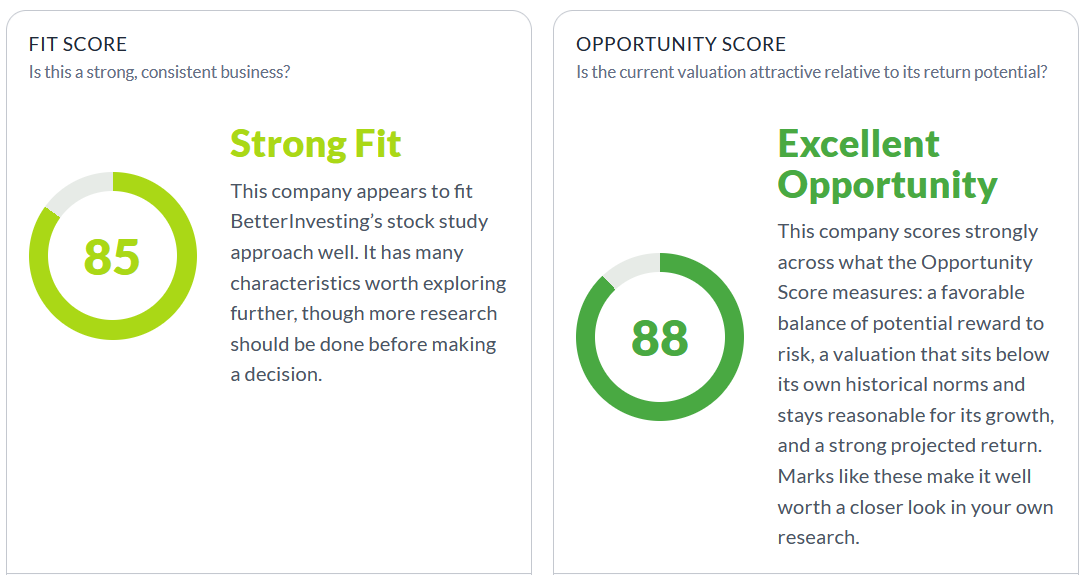
Subscribe today to unlock this infill logistics powerhouse that's acquiring prime industrial real estate across land-constrained markets and is perfectly positioned for accelerating cash flow and compounding reliable small-cap dividend growth.
Stay the course!
— DOUG GERLACH